

A data catalog
built for data
you can trust
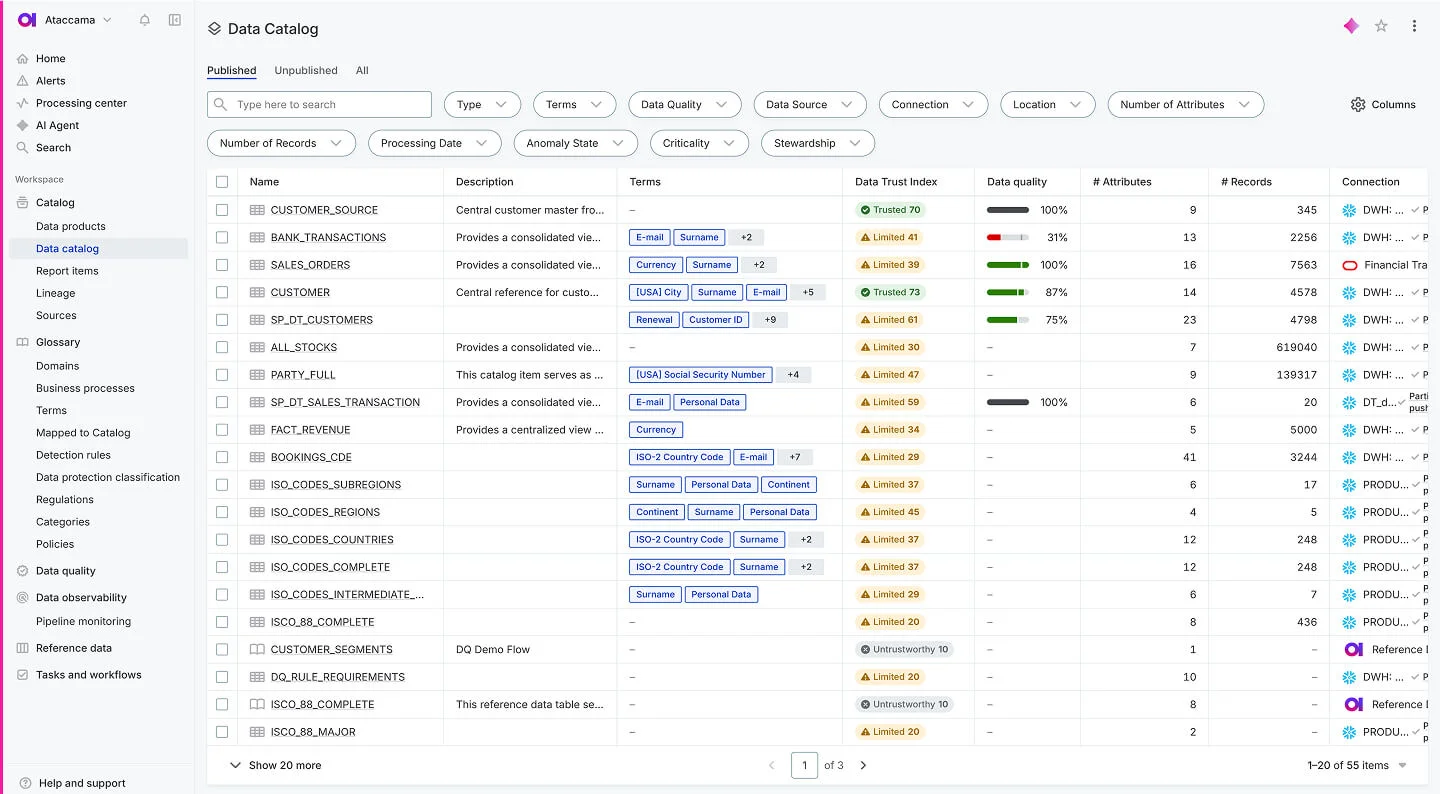
Most data catalogs stop at the data inventory. Ataccama builds the metadata foundation your teams and AI need, with business context, quality scoring, observability, and lineage on every asset, continuously maintained.











The gap between documented and trusted data
Your teams spend time searching for, reconciling, and verifying data. Your AI initiatives stall because no one can vouch for the inputs. Your governance program has a catalog but a data catalog software alone doesn't tell you whether you can trust your data or what it means. AI agents and analysts don't consume raw tables; they consume trusted context.
The gap between documented and trusted data is where most data governance programs break down. Ataccama closes it.
What makes Ataccama’s enterprise data catalog
the smarter choice
Make data discoverable and governed
-
Connectivity across your entire data landscape
Catalog every data asset — relational and NoSQL databases, cloud warehouses, data lakes, BI tools, streaming platforms, and more. With 100+ out-of-the-box connectors spanning AWS, Azure, Google Cloud, Snowflake, and beyond, Ataccama ONE integrates with your existing data landscape.
-
Governed data products
Publish and manage reusable, AI-ready data products with business context, assigned owners, and a clear contract of data quality and trust. Criticality flags ensure governance effort focuses on what matters most. Certified datasets become discoverable and consistent across the organization.
-
Clear stewardship
Assign owners, stewards, and domain experts to every asset, with ONE AI Agent as your always-on digital steward filling the gaps. Mix centralized and federated governance to match how your organization works, with full accountability through clear, role-based ownership.
-
Flexible access management
Set group-level access controls with workflows for requests, approvals, and policy reviews — all without leaving the platform. From organization-wide policies to team-specific permissions, the right people always have access to the right data.
-
Collaborate without switching tools
Organize and track tasks with a kanban view, assign work across data engineers, stewards, and owners, and keep the conversation in context with comments, threads, and mentions directly on data assets.
Scale governance with AI
-
ONE AI Agent
Eliminate manual stewardship effort with your always-on digital data steward. With our AI capabilities, you can generate asset descriptions, create new catalog items, assign business terms, generate and debug quality rules, and more.
-
Continuous updates at scale
Keep your catalog accurate as environments evolve. Ataccama refreshes metadata, flags anomalies, and reflects structural changes without manual effort. Coverage doesn't degrade between stewardship sprints.
-
You stay in control
Review and approve AI proposals. Every suggestion is reviewable and transparent, so you get the speed of automation without losing accountability.
Build your semantic foundation
-
Data profiling & classification
Profile automatically every connected source for duplicate counts, null rates, domain patterns, and more. AI-learned classification detects business domains and sensitive data, mapping assets to your organization's vocabulary at scale, without manual tagging.
-
Business glossary & metadata management
Define and manage terms, hierarchies, and relationships, linked to quality rules, policies, and data products, forming the semantic layer AI agents query before touching a table. Extend the metadata model beyond tables and columns to track health scores, reports, systems, and more.
-
A semantic layer for humans and AI
Give every consumer — analysts, BI tools, and AI agents alike — the context they need to act. Rather than reaching for data directly, they reach for its meaning first: business terms, trust scores, quality signals, classifications, and lineage, all connected to every asset and accessible via MCP server.
-
Cloud data platform integration
Connect Ataccama to both Snowflake Horizon and Databricks Unity Catalog, enriching their semantic layer with cross-platform quality, trust scoring, and lineage. Through its OSI collaboration, Ataccama carries consistent semantics and governance across platforms.
Trust and act on your data
-
Maintain data quality automatically
Apply prebuilt rules or create custom ones with ONE AI Agent. Continuously monitor data quality, detect domains and changes, and manage reference data to ensure consistent, AI-ready data.
-
Data trust scores on every asset
Score every catalogued asset automatically with a trust score derived from quality and governance signals. Quality and trust metrics surface directly on catalog pages, so you never need to switch tools to understand whether an asset is reliable.
-
Augmented data lineage
Trace data across all connected systems, enriched with business terms and built-in data quality overlays. Understand not just where data came from, but whether it was trustworthy at each step.
-
Data monitoring and observability
Monitor for anomalies, schema drift, and quality shifts across all cataloged sources, continuously. Detect, triage, and validate the health of your data assets and pipelines, and remediate issues before they reach downstream reports, dashboards, or AI models.
An automated catalog your whole
organization will actually use

For CDOs and data leaders
You're accountable for AI readiness, regulatory compliance, and the data programs that underpin both. Ataccama gives you a catalog with built-in data quality, observability, and lineage so you can report on the state of your data estate with confidence, not estimation. When asked whether your data is ready for AI, you'll have the answer.

For data stewards and governance teams
Stop chasing asset owners and manually maintaining metadata that's stale the moment you publish it. Ataccama automates classification, term assignment, and quality monitoring so stewardship effort goes toward decisions, not data entry. With technical and business users aligned on ownership, policies, and governance workflows, federated stewardship becomes a daily practice, not a roadmap item.

For data consumers and analysts
Finding a reliable dataset shouldn't require knowing who built it, where it lives, or investigating whether it can be trusted. Ataccama surfaces recommended assets with trust scores, business context, and clear ownership as reusable data products so teams can find and access data they can actually use, without filing a ticket or chasing a Slack thread.


Experience
the Ataccama difference
Stronger data initiatives
with improved business outcomes
management
in the first 3 years
Estimate the potential ROI of Ataccama with our calculator.
Prove the value of your data in minutes.
Customer stories
Real-world case studies from our customers


From spreadsheets to auditable data quality: How SSEN Transmission built regulatory-ready data governance
SSEN Transmission eliminated manual data reconciliation, achieved 99% cross-system asset consistency for a priority dataset, and built a continuously monitored data quality foundation to support regulatory reporting.
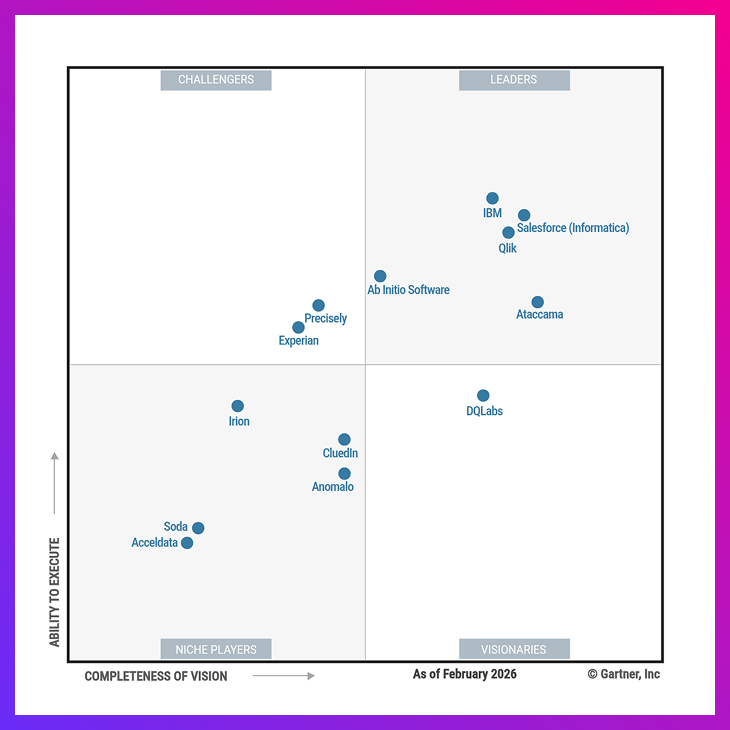
5-time Leader, with the furthest vision
Ataccama positioned as a Leader in the 2026 Gartner® Magic Quadrant™
for Augmented Data Quality Solutions for 5th consecutive time.




Discover practical use cases
See how Ataccama ONE Data Catalog can address your specific business needs.
Tailored for your industry
Learn how businesses in your industry are leveraging Ataccama for success.
FAQ
A data catalog tool is software that helps organizations discover, organize, and govern their data assets across the enterprise. It creates a centralized, searchable inventory of data sources, enriched with metadata, business context, and quality information, so teams can find and trust the data they need for analytics, reporting, and AI.
Ataccama Data Catalog goes beyond traditional cataloging by embedding data quality monitoring, anomaly detection, and lineage directly into the catalog. This unified approach means teams spend less time searching for and validating data, and more time acting on trusted insights for regulatory reporting, Customer 360 initiatives, and AI model training.
The ONE AI Agent automates data discovery by scanning connected sources, assigning business terms, suggesting quality rules, detecting patterns, and uncovering relationships across systems. It also enables non-technical users to create reusable data quality rules from plain language descriptions and automatically classifies data based on business context, reducing manual cataloging effort significantly.
An enterprise data catalog should include automated data discovery and profiling, built-in data quality monitoring, augmented data lineage, a business glossary with governance workflows, and role-based access controls. It should also support data products and a marketplace for sharing governed, reusable datasets, along with collaboration tools like task management and commenting to bridge technical and business teams.
Yes. The platform combines curated and federated governance models, giving organizations the flexibility to set team-level or global access controls based on their needs. Custom approval workflows for access requests and policy reviews, granular stewardship roles, automated data classification for sensitive data like PII, and detailed audit trails all support regulatory compliance and data protection requirements.
Industries with large, distributed data estates and strict governance requirements benefit most. Financial services, insurance, and manufacturing organizations use data catalog solutions to build enterprise-wide data governance programs, protect sensitive data, ensure regulatory reporting accuracy, and prepare trusted data for AI and machine learning initiatives.
A data dictionary documents the technical structure of a specific database or system such as table names, field types, and definitions. A data catalog is broader: it inventories data assets across your entire landscape and layers on the business context, quality scores, ownership, and lineage that tell people whether they can trust and reuse each asset. Put simply, a data dictionary describes what a field is; a data catalog tells you what data exists, what it means, and whether you can rely on it.